Charlie’s Ride

© Matthew Word Bain

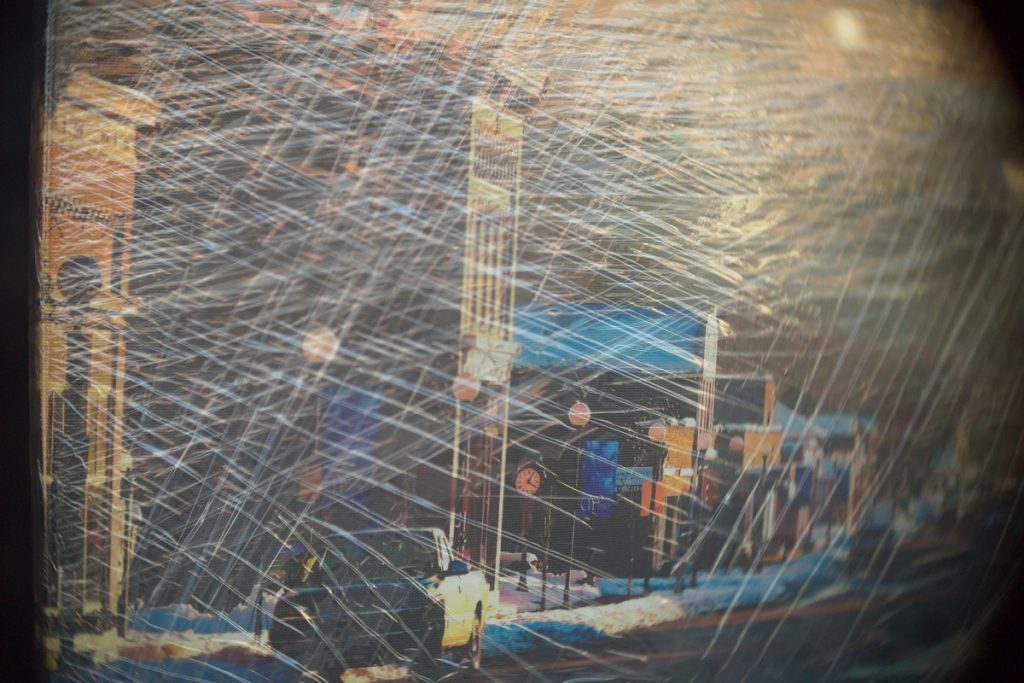
one person had not been afraid
Charlie pulled up in his silver Charger
in the light of that late afternoon
prepared to make contact

he made contact alright –
he was welcomed aboard
and soon found out all about
what lay behind those dark windows
and that cheerful orange exterior

when two worlds meet
they can be hard to reconcile
Charlie never did feel quite so at home
in his old home town after that day

even if he had found a way
to explain all that he saw
he knew it strained credulity
and no one could both believe it
and be sane – let alone stay that way

and so Charlie spent his days
waxing that earthbound Dodge
trying not to make sense of two worlds
for the sake of living in just one

he never let himself believe
it had only been a dream
he could tell what was real
besides, if one world is a dream
what does that say about the other?

Charlie’s Ride Read More »

Unidentified

© Matthew Word Bain

they tried to hush it up
but the thing had already been seen
there was little to be done
besides wonder
and keep a safe distance
try and keep the dogs from barking
and the children safe at home
was it here to stay?
there was one thing certain
no craft clad in such cheerful color
was soon to be forgotten in this small town
at least not until morning
when people came to their senses
and rubbed their sleepy eyes
was it only a dream?

Unidentified Read More »

Littoral Tread

© Matthew Word Bain

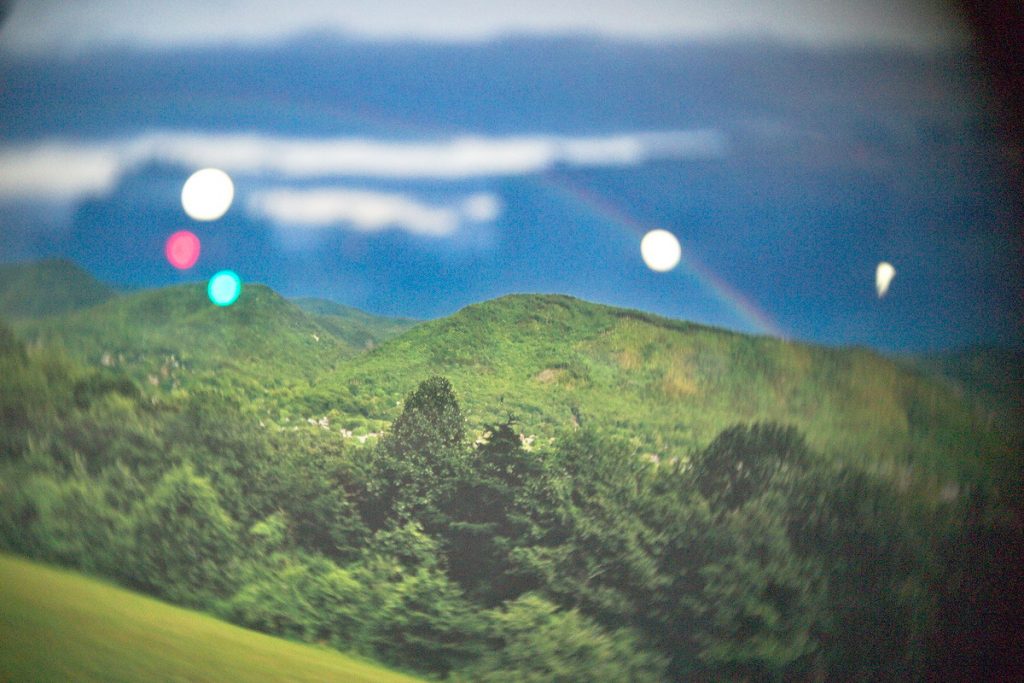
treading in shallow water
on the trail of the elusive Vaccinium
life in the liminality of the littoral zone
with all its literal ups and downs
inspires me as it always does
so I soak this in while in its presence
wanting to absorb something of its resilience
to which I can then later turn
when I find myself in liminal zones
and not so much treading in shallow water
as treading water in the depths

Littoral Tread Read More »

Whole Rabbit

© Matthew Word Bain

liberated from the subterranean realms
and looking quite at home in the summer sky
if only for a moment, as visions like this never last
I find myself marveling at this creature
I’m more accustomed to finding
upon taking my bearings
after falling down a deep hole
and whose tracks tend to lead me
to tea parties with mercurial haberdashers
and two dimensional representations of royalty
with their frightening whims and unimaginable views
and yet, here I am craning my neck at the heavens
and watching this out of place shapeshifter
soon to be transmogrified by time
and the drift of the wind
this momentary representation
of a form I know from a grounded setting
and so it seems that cloud gazing
and going down rabbit holes
have more in common than I knew
as the old maxim states:
as above, so below

Whole Rabbit Read More »

Blogging on the Edge of Chaos

I looked into blogging a few years ago, hoping to make a living and change the world. I got discouraged. It didn’t seem like making a living blogging was within my reach, and I thought I needed to get the world’s attention before I could change it. But recently I encountered a much simpler, more human scale perspective on blogging, from someone who has been doing it for a long time. Seth Godin’s blog is free, contains no ads, and he posts on it every day. He encourages people to blog as a way of “building a tribe.” I’d like to build a tribe, a group with which I resonate, within which I feel I belong, where my principles are in alignment with that of the group, in which I am respected and accountable for whom I have demonstrated myself to be. I have for most of my life felt a certain deficit of meaningful connection – perhaps, ironically, I am not alone in that regard. I am now seeking connection through blogging. Thank you for joining me!

Godin is not the only person inspiring me to launch this endeavor, however. I must also thank Stephen Harrod Buhner and Michael Crichton. Resonant material from two disparate sources encountered a couple weeks apart converged in my mind as I heard the second source speak. The latter was Godin, speaking at his 2012 Startup School, talking about what makes people feel like they have achieved their purpose. He says it is:

“to dance on the edge of failure. I think that when people are dancing on the edge of failure, and they’re growing, and there’s a void over there but they keep moving forward – that’s when we feel alive as people. There are a few people who don’t have that – it’s been boiled out of them or raised out of them or whatever – but generally, it’s that getting close to the precipice that I think is ingrained in who we are as people. What industrialists did for a hundred years is they brainwashed us into not believing that – because they don’t want you to do that – they want you to need them. Because if you need them you’ll work for cheap, and if you need them you’ll comply, and they’ll be able to make more money. And now the industrial age is ending, and all these opportunities are showing up in front of us, and so we’re calling everybody’s bluff.”

This really caught my attention. It is utterly accurate in terms of my own experience in the past, and it reframes my own perspective in the present, moving the lens away from the search for safety and stability and toward instead where I am on the path forward toward what it is I want in the future. But even better than all that, it was a remarkable echo of a Michael Crichton quotation, which I read as quoted in Stephen Harrod Buhner’s Plant Intelligence and the Imaginal Realm: Beyond the Doors of Perception and into the Dreaming of Earth, and which originates in Crichton’s book “The Lost World.” The quote appears in a chapter called “Everything is Intelligent,” amidst a disquisition on the emergent behaviors manifesting just across the threshold of self-organization.

“Even more important is the way complex systems seem to strike a balance between the need for order and the imperative for change. Complex systems tend to locate themselves at a place we call ‘the edge of chaos.’ We imagine the edge of chaos as a place where there is enough innovation to keep a living system vibrant, and enough stability to keep it from collapsing into anarchy. It is a zone of conflict and upheaval, where the old and new are constantly at war. Finding the balance point must be a delicate matter – if a living system drifts too close, it risks falling over into incoherence and dissolution; but if the system moves too far away from the edge, it becomes rigid, frozen, totalitarian. Both conditions lead to extinction . . . Only at the edge of chaos can complex systems flourish.”

Each of us, as a human being, is a self-organized system. Looking within, each of our cells is a self-organized system. Looking without, the biosphere is a self-organized system. Self-organization occurs in nested hierarchies. It is a mysterious phenomenon.

On one side of the threshold there is only random molecular motion. Once a critical density has been achieved, the threshold is crossed and the whole becomes larger than the sum of its parts. At this point emergent behavior arises, and this new system can no longer be understood by any reductionist approach. Within a self-organized system there is information being processed about what is happening within and without this unit of self, leading to greater stability of the self-organization, and ultimately to greater ability to respond dynamically to ever changing internal and environmental stimuli.

Terence McKenna used to encourage people to ask what the ecological purpose of a phenomenon was. I have asked this question most often about the occurrence of Homo sapiens sapiens, as well as the surge of this species’ population across the planet. Self-organization occurs as a phase transition, once a critical mass is achieved. There is no way to predict what that critical mass will be prior to its occurrence. We seem to be approaching a critical mass of humanity on the planet right now. This usually comes up in conversation about natural resources, extinction, etc., – but what if it were instead about the threshold that stands between random unconnected behavior and the emergent behavior of self-organization? What if we were on the verge ofcreating a new self-organized system – not unlike the concept of the Noosphere – in which each individual has and maintains autonomy and is simultaneously aware of itself as part of a larger whole – a newly formed, literally superhuman organism. It’s as wild an idea as it is a speculation, but I think it makes for a fascinating question. And if that is not the ecological function of the surge of the human population on the planet, what else might be?

Whether as part of a larger self-organized human structure, or as a smaller part of the Gaian organism, but certainly as self-organized systems each of us, we are in fact dancing on the edge of chaos, on the edge of failure right now. This is true both moment to moment as the simple reality of self-organized systems, as well as true for us as a species seemingly bent on destroying its habitat. I am inspired to embrace it: to dance on the edge of the void, the edge of chaos, the edge of failure. That’s where the good stuff is, and it’s where I am finding I feel most at home.

Blogging on the Edge of Chaos Read More »